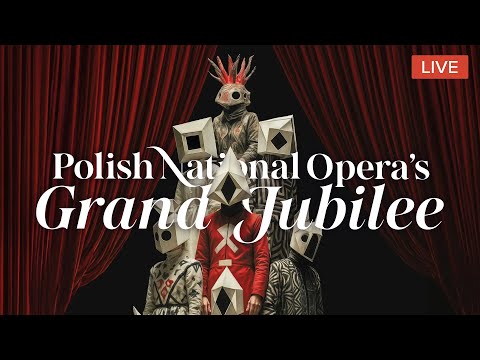
Opera in 16 scenes
Libretto: Beniamin M. Bukowski after the novel Najlepsze miasto świata by Grzegorz Piątek
World premiere: 19 September 2025, Polish National Opera, Teatr Wielki
Co-producer: Sinfonia Varsovia
In the original Polish with Polish and English surtitles
The opera was commissioned by the Sinfonia Varsovia thanks to the financial support of the City of Warsaw.
The opera’s world premiere on 19 September 2025 inaugurates the 68th International Warsaw Autumn Festival of Contemporary Music.
The post-war reconstruction of the Teatr Wielki took twenty years to complete. The opera house’s reopening in 1965 was a momentous event that demonstrated the scale of wartime damage and the residents' determination to rebuild the city from the ashes. In 2025 the Polish National Opera will give a debut to an opera that tells the story of Warsaw’s reconstruction, marking eighty years since the arduous process began.
The source of inspiration for the opera was Grzegorz Piątek’s book Najlepsze miasto świata. Warszawa w odbudowie 1944–1949 [The Best City in the World: Warsaw Under Reconstruction 1944–1949], which looks into the first years of the mammoth endeavour which brought together people of various viewpoints in a gesture of defiance against wartime destruction.
Beniamin Bukowski wrote the libretto tapping into archival sources: political discourse, urban design parlance, and street vernacular. This is not, however, a historical chronicle but a tale of interwoven human lots.
The opera’s two protagonists are women. One is a modernist architect modelled on Helena Syrkus, whose pre-war dream of redesigning the city to make it more functional has turned into gruesome reality. The other one is an American journalist inspired by Anne Louise Strong, a US reporter fascinated by Communism who travelled across worn-torn Poland with the Red Army. Their meeting will force the women to completely shift their perspectives.
Composed by Cezary Duchnowski, the score combines orchestral sound with electronic music. The juxtaposition of solo parts and choruses makes it possible to shift the perspective on the city’s ordeal from general to personal. For the Warsaw-born director Barbara Wiśniewska the opera has a personal meaning as a reflection of her family history. At the same time, Wisniewska is interested in the broader social significance of the city’s destruction and reconstruction: a generational trauma that was successfully transformed into a joint endeavour of unparalleled scale.
An Opera about Warsaw is not just an account of the tragic and glorious chapters in the city’s history but a very modern piece about the life of a metropolis suspended between the vision of urban planners and architects, political ideologies, and the needs and dreams of its residents.
OBSADA / CAST:
DZIENNIKARKA / JOURNALIST Joanna Freszel
ARCHITEKTA / ARCHITECT Agata Zubel
PRZEWODNIK / GUIDE Filip Kosior
REALIZATORZY / CREDITS:
DYRYGENT / CONDUCTOR Bassem Akiki
REŻYSERIA / DIRECTOR Barbara Wiśniewska
SCENOGRAFIA / SET DESIGNER Natalia Kitamikado
KOSTIUMY / COSTUMES Emil Wysocki
CHOREOGRAFIA / CHOREOGRAPHY Maćko Prusak
DRAMATURGIA / DRAMATURGY Marcin Cecko
REŻYSERIA ŚWIATEŁ / LIGHTING DIRECTOR Aleksandr Prowaliński
PROJEKCJE VIDEO / VIDEO PROJECTIONS Bartek Macias
PRZYGOTOWANIE CHÓRU / CHORUS MASTER Łukasz Hermanowicz
PRZYGOTOWANIE CHÓRU DZIECIĘCEGO / CHILDREN'S CHORUS MASTER Danuta Chmurska
CHARAKTERYZACJA / MAKE-UP Mateusz Stępniak
REALIZACJA PARTII ELEKTRONICZNEJ, PROGRAMOWANIE MEDIÓW Cezary Duchnowski, Marcin Rupociński